

NMN Strips vs NMN Capsules: An Honest Comparison

An NMN strip from Smart Strips contains 80 mg of nicotinamide mononucleotide and dissolves on the tongue in 7 to 30 seconds, while NMN capsules are swallowed and are usually labelled at several hundred milligrams per serving. Published human studies have used daily intakes from 250 mg to more than 1000 mg (Igarashi, 2022; Yi, 2023; Fukamizu, 2022), so the honest summary is this: capsules win on milligrams, the strip is designed as a daily habit with a different route of entry.
This page sets out what NMN is, what the human research has looked at, where 80 mg sits next to those numbers, and why the oral dissolvable strip format is interesting for a molecule like this one. We make no promises about how NMN will feel, because for most people it will not feel like anything.

01
What is NMN, and what does it have to do with NAD+?
NMN, short for nicotinamide mononucleotide, is a molecule the body uses to make NAD+ (nicotinamide adenine dinucleotide). NAD+ is present in every cell and takes part in hundreds of reactions linked to how cells convert food into energy and maintain themselves.
Small human studies have measured lower NAD+ levels in older adults than in younger ones, both in skin samples and in blood plasma (Massudi, 2012; Clement, 2019). That observation is the reason NMN became a subject of longevity research: if NMN is a precursor of NAD+, researchers wanted to know whether taking it raises NAD+ in people.
Small amounts of NMN also occur naturally in foods such as broccoli, cabbage, edamame and avocado, though in quantities far below supplemental doses.
One clear statement before we go further. In the European Union there are no authorised health claims for NMN; the EU list of permitted claims contains none (Regulation (EU) No 432/2012). Everything on this page describes research and format, and none of it is a promise about health, ageing or energy. On the safety side, the European Food Safety Authority (EFSA) published a positive opinion on β-NMN on 11 May 2026, for adults at up to 300 mg a day, excluding pregnant and breastfeeding women (EFSA NDA Panel, 2026). The wider regulatory picture is set out in our NMN guide.
02
What have human studies on NMN found?
Human research on oral NMN is young but growing. Most randomised trials so far have been small, lasted weeks rather than years, and measured NAD+ levels in blood, safety and selected markers (Yi, 2023; Igarashi, 2022; Fukamizu, 2022).
Two examples show the scale. A 2023 trial randomised 80 healthy middle-aged adults to 300, 600 or 900 mg a day for 60 days; blood NAD concentrations rose in all three NMN groups, and the authors reported no safety issues at any of the doses tested (Yi, 2023). A 2022 safety study gave 1250 mg a day for up to four weeks to 31 healthy adults aged 20 to 65, and no severe adverse events were observed (Fukamizu, 2022).
What the research has not yet shown is long-term outcomes in people. Trials lasting years, in large groups, do not exist yet. Anyone who tells you NMN reverses ageing is ahead of the evidence.
03
How does 80 mg compare with clinical doses?
80 mg is below the doses used in the published human trials. We state it plainly because you would see it on any comparison chart anyway.
The reason is the format. An oral dissolvable strip is a thin pullulan film that has to melt on the tongue within seconds, and there is a physical limit to how much active ingredient fits into it. 80 mg is a substantial load for a strip that is designed to dissolve quickly.
80 mg a day makes sense for people who see NMN as a consistent daily habit rather than a high-dose protocol. For people who want to start with NMN before deciding on anything larger. And for people who already take capsules and want a form that travels: the sachet is light and compact and goes anywhere with you, in a pocket or a carry-on.
What 80 mg is not: an equivalent of 500 mg in a capsule. We do not claim that the strip format multiplies the dose, and we have no study showing NAD+ levels after 80 mg in strip form.
04
Why does the strip format matter for a molecule like NMN?
When you swallow a capsule, its contents pass through the stomach and intestine before they reach the circulation. For NMN, research in animals shows that part of a swallowed dose is converted in the gut, and how intact NMN is taken up is still debated: a 2019 study in mice described an intestinal transporter for NMN, and other researchers disputed that interpretation the same year (Grozio, 2019; Schmidt and Brenner, 2019).
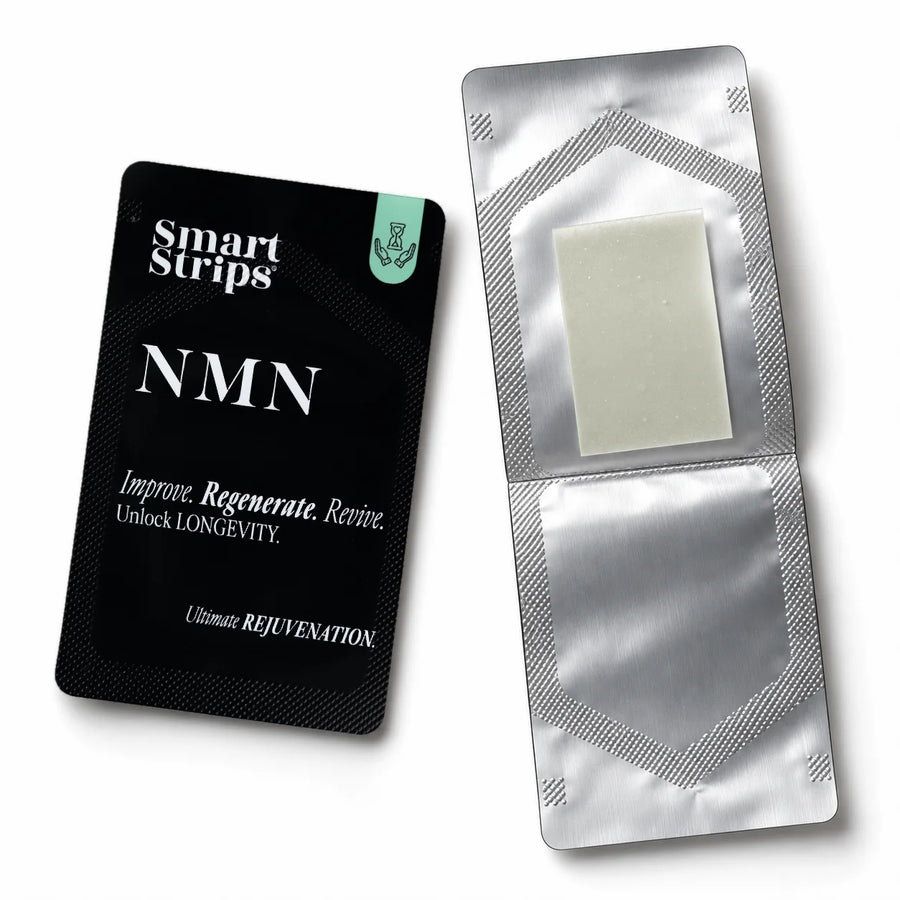
An oral dissolvable strip takes a different route for part of the dose. It dissolves on the tongue, and part of the dose is absorbed through the lining of the mouth. Under the tongue that lining is only 100 to 200 µm thick (Hua, 2019), and the oral mucosa is described as “4-4000 times more permeable than that of skin” (Patel, 2011). For the portion absorbed this way, first-pass metabolism in the liver is significantly reduced. The rest is swallowed with saliva in the usual way.
Medicine shows what this route can do for some molecules. Selegiline, in a form that dissolves in the mouth, reaches peak blood levels in 10 to 15 minutes, against 40 to 90 minutes for the swallowed tablet (ZELAPAR prescribing information). In clinical studies of several medicines, an oral film delivered the same amount of active ingredient as the matching tablet (Radicioni, 2017; Park, 2018). These are drug data, not NMN data. For the Smart Strips QuickRelease™ format as a whole, the brand works with up to 95% bioavailability, up to 4x faster absorption, up to 30% higher effectiveness. Whether and how much NMN specifically crosses the oral mucosa in humans is still an open question.
That is why we call the strip interesting for NMN and stop short of calling it better. It is a reasonable format for a molecule that has a long way to go through the gut, and the human data on that specific question is still to come.
05
NMN strip vs NMN capsule: side by side
| NMN oral dissolvable strip | Typical NMN capsule | |
|---|---|---|
| NMN per serving | 80 mg | Usually several hundred mg per serving |
| Doses used in human trials | Below the published range | Within the published range of 250 mg to more than 1000 mg a day |
| Route | Dissolves on the tongue; part absorbed through the oral mucosa, the rest swallowed | Swallowed; passes through stomach and intestine |
| Time to take | About 7 seconds to place; dissolves in 7 to 30 seconds | Needs water |
| Water needed | No | Yes |
| Suits people who | Find pills hard to swallow, travel often, want a habit they keep | Want a higher milligram dose |
| Portability | Light, compact sachet, goes in any bag | Bottle or pill case |
| What you will feel | Nothing in particular; NMN is a habit, not a sensation | Same |
| Pack | 30 strips, 49 EUR / $56 | Varies widely |
06
When are capsules the better choice?
When the dose is the goal. If you want to follow the amounts used in human trials, a capsule of 250 mg or more gets you there in one swallow, and an 80 mg strip will not.
Capsules also make sense if you are already taking NMN at a dose agreed with your doctor and are happy with the routine.
07
When does an NMN strip make more sense?
The strip suits a different person: someone over 35 with an ordinary, busy life, who likes the idea of supporting a long-term habit but has a drawer of half-finished pill bottles to prove how habits go.
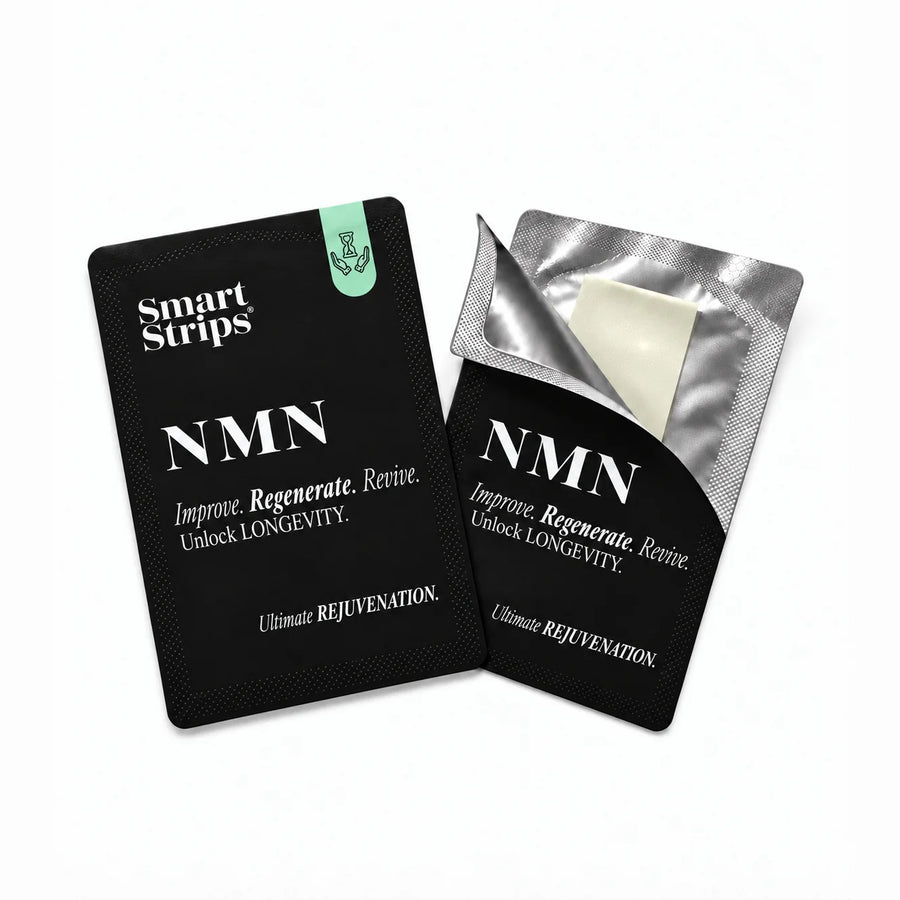
On a regular weekday you leave at 7:20, the vitamins stay on the kitchen counter, and by evening you have forgotten them again. With a sachet in your pocket or bag the ritual moves with you. Taking the strip out and placing it on your tongue takes about seven seconds, what we call the 7-second ritual, and there is no water or swallowing involved.
The strip also suits people who simply dislike capsules. About 14% of older adults living at home have difficulty swallowing medicines (Mc Gillicuddy, 2016), and NMN capsules are rarely small.
08
How is the quality of the NMN checked?
The quality of NMN depends on the purity of the raw material and on how it is handled. Smart Strips NMN is made in the USA, in an FDA registered, cGMP certified facility.
When you compare NMN products of any format, look for three things on the brand’s side: a stated amount of NMN per serving, a willingness to share testing information on request, and a production facility that works to recognised manufacturing standards.
09
How to take NMN strips
Place one strip on your tongue and let it dissolve. One strip a day, ideally in the morning. Consistency matters more than the time of day.
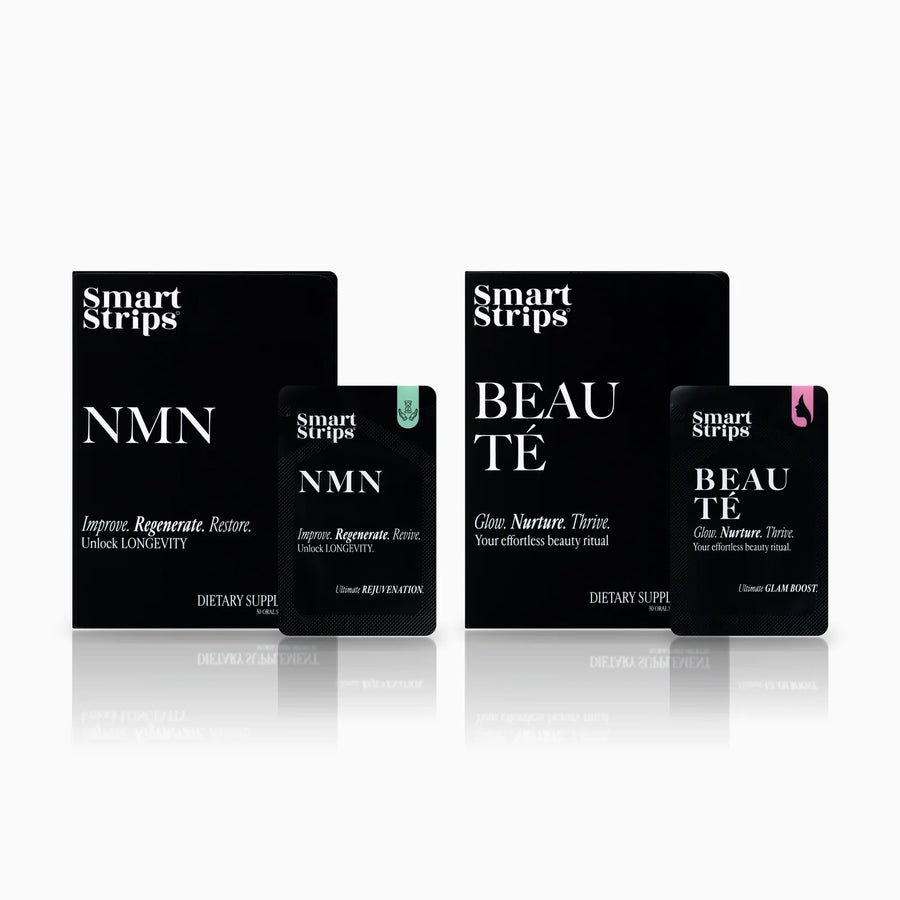
If you are building a broader routine, the Longevity Ritual bundle pairs NMN with BEAUTÉ, two boxes for a daily morning routine. Consult your doctor if you are pregnant, nursing, taking medication or have a medical condition.

10
Frequently asked questions
Is 80 mg of NMN enough?
80 mg is below the intakes of 250 mg a day and more used in human trials (Igarashi, 2022; Yi, 2023). It is designed as a consistent daily habit, not as a clinical-dose protocol.
Will I feel the effect of NMN?
Most people should not expect to feel anything. NMN is best understood as a long-term daily habit.
Is sublingual NMN better than capsules?
There is no published human comparison for NMN yet. Part of a strip’s dose is absorbed through the oral mucosa, and for that portion first-pass liver metabolism is significantly reduced, but how much NMN takes this route has not been measured.
Are there approved health claims for NMN?
No. In the EU there are no authorised health claims for NMN. EFSA’s positive opinion of 11 May 2026 on β-NMN is a safety assessment for adults at up to 300 mg a day, excluding pregnant and breastfeeding women. More background is in our NMN guide.
How fast does an NMN strip dissolve?
The NMN oral dissolvable strip dissolves on the tongue in 7 to 30 seconds. No water is needed.
Can I take NMN strips together with capsules?
Many people combine formats. Agree the total daily amount with your doctor, especially if you take medication.
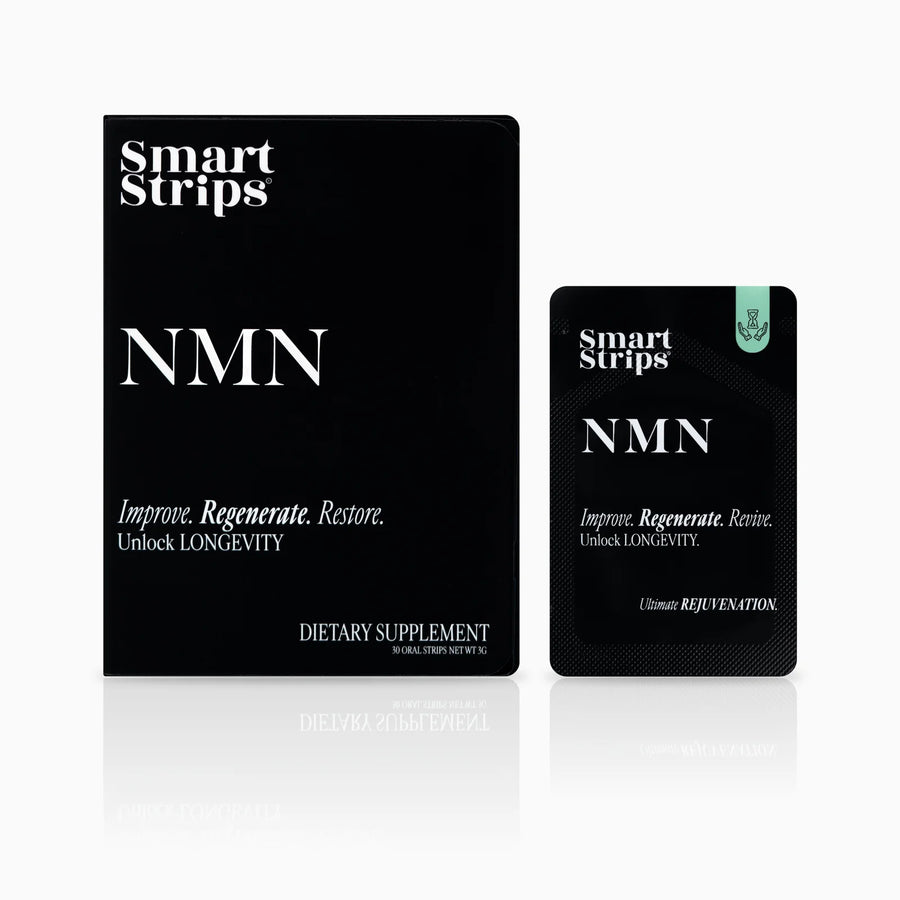
NMN comes in boxes of 30 oral dissolvable strips. You will find the full label on the NMN page. For another honest format comparison, see collagen strips vs collagen powder.
11
Sources
- Igarashi M, Nakagawa-Nagahama Y, Miura M, et al. Chronic nicotinamide mononucleotide supplementation elevates blood nicotinamide adenine dinucleotide levels and alters muscle function in healthy older men. npj Aging. 2022;8:5. DOI 10.1038/s41514-022-00084-z
- Yi L, Maier AB, Tao R, et al. The efficacy and safety of β-nicotinamide mononucleotide (NMN) supplementation in healthy middle-aged adults. GeroScience. 2023;45:29-43. DOI 10.1007/s11357-022-00705-1
- Fukamizu Y, Uchida Y, Shigekawa A, Sato T, Kosaka H, Sakurai T. Safety evaluation of β-nicotinamide mononucleotide oral administration in healthy adult men and women. Sci Rep. 2022;12:14442. DOI 10.1038/s41598-022-18272-y
- Massudi H, Grant R, Braidy N, Guest J, Farnsworth B, Guillemin GJ. Age-associated changes in oxidative stress and NAD+ metabolism in human tissue. PLoS One. 2012;7(7):e42357. DOI 10.1371/journal.pone.0042357
- Clement J, Wong M, Poljak A, Sachdev P, Braidy N. The Plasma NAD+ Metabolome Is Dysregulated in “Normal” Aging. Rejuvenation Res. 2019;22(2):121-130. DOI 10.1089/rej.2018.2077
- Commission Regulation (EU) No 432/2012 establishing a list of permitted health claims made on foods, other than those referring to the reduction of disease risk and to children’s development and health. Annex. https://eur-lex.europa.eu/legal-content/EN/TXT/?uri=CELEX:32012R0432
- EFSA Panel on Nutrition, Novel Foods and Food Allergens (NDA). Safety of beta-nicotinamide mononucleotide (β-NMN) pursuant the regulation (EU) 2015/2283 and the bioavailability of nicotinamide from this source in the context of Directive 2002/46/EC. EFSA Journal. 2026;24(5):e10007. DOI 10.2903/j.efsa.2026.10007
- Grozio A, Mills KF, Yoshino J, et al. Slc12a8 is a nicotinamide mononucleotide transporter. Nat Metab. 2019. DOI 10.1038/s42255-018-0009-4
- Schmidt MS, Brenner C. Absence of evidence that Slc12a8 encodes a nicotinamide mononucleotide transporter. Nat Metab. 2019;1:660-661. DOI 10.1038/s42255-019-0085-0
- Hua S. Advances in nanoparticulate drug delivery approaches for sublingual and buccal administration. Front Pharmacol. 2019;10:1328. DOI 10.3389/fphar.2019.01328
- Patel VF, Liu F, Brown MB. Advances in oral transmucosal drug delivery. J Control Release. 2011;153(2):106-116. DOI 10.1016/j.jconrel.2011.01.027
- ZELAPAR (selegiline hydrochloride) orally disintegrating tablets, US Prescribing Information, section 12.3. https://medlibrary.org/lib/rx/meds/zelapar/page/5/
- Radicioni M, Castiglioni C, Giori A, Cupone I, Frangione V, Rovati S. Bioequivalence study of a new sildenafil 100 mg orodispersible film compared to the conventional film-coated 100 mg tablet administered to healthy male volunteers. Drug Des Devel Ther. 2017;11:1183-1192. DOI 10.2147/DDDT.S124034
- Park S-I, Heo S-H, Kim G, et al. Comparison of tadalafil pharmacokinetics after administration of a new orodispersible film versus a film-coated tablet. Drug Des Devel Ther. 2018;12:935-942. DOI 10.2147/DDDT.S155040
- Mc Gillicuddy A, Crean AM, Sahm LJ. Older adults with difficulty swallowing oral medicines: a systematic review of the literature. Eur J Clin Pharmacol. 2016;72(2):141-151. DOI 10.1007/s00228-015-1979-8
7 to 30s
To dissolve on the tongue
8×5cm
Sachet, business card size
30
Strips, one month
10
Formulas, one format