

Caffeine Strips vs Pre-Workout Powder: How Much Caffeine Does a Workout Need?

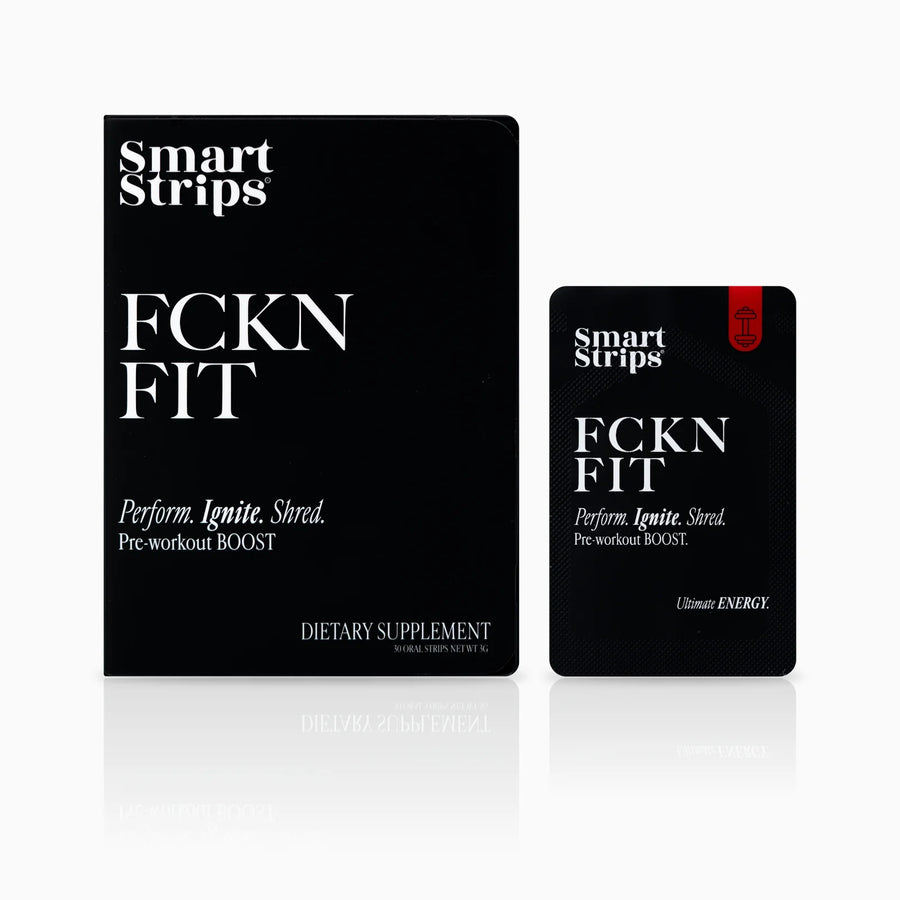
A scoop of pre-workout powder can carry several hundred milligrams of caffeine, while a Smart Strips FCKN FIT oral dissolvable strip carries 20 mg and dissolves on the tongue in 7 to 30 seconds, without water or a shaker. That gap is intentional. FCKN FIT is designed for clean, light energy before training, and it leaves out the hour of feeling wired and on edge that often follows a heavy scoop.
01
How much caffeine is in a typical pre-workout powder?
More than most people assume. When researchers measured the caffeine in pre-workout supplements popular with Australian consumers, they found 91 to 387 mg per serving (Desbrow et al., Drug Testing and Analysis, 2019). In the US, an analysis of the labels of the 100 best-selling pre-workout powders found caffeine in 86% of them, with an average of about 254 mg per serving (Jagim et al., Nutrients, 2019).
For perspective, the European Food Safety Authority considers single doses of caffeine up to 200 mg to raise no safety concerns for healthy adults, and up to 400 mg across a whole day (EFSA Scientific Opinion on the safety of caffeine, 2015). A single serving at the top of that measured range is close to a full day’s allowance before you have had your morning coffee. Many people also add a second scoop on a tired day, which the label rarely encourages and the tub makes easy.
02
Why does FCKN FIT contain only 20 mg of caffeine?
Because the goal is to feel ready and stay calm. According to the European Food Safety Authority, a 60 ml espresso contains about 80 mg of caffeine and a 200 ml cup of filter coffee about 90 mg, so 20 mg is roughly a quarter of an espresso. It is a light, countable amount, chosen so that the warm up does not start with your pulse in your ears.
Here is the scene most gym regulars know. The scoop goes in at six, training starts at quarter past, and by twenty past you are restless before the first set and your heart is moving faster than the treadmill. You finish the workout and stay wired for another hour, then try to sleep at eleven. Caffeine research does not only look at large amounts: laboratory studies have tested doses as small as 12.5 mg (Smit and Rogers, 2000) and 32 mg (Lieberman et al., 1987). In the EU, though, no health claim for caffeine is authorised, so we describe FCKN FIT by what it contains.
FCKN FIT takes the opposite approach: a small amount of caffeine, supported by ingredients chosen for the training itself. It works for a 7 a.m. session before the office and for a 7 p.m. session that should still end in a normal night’s sleep.
03
What else is in an FCKN FIT strip?
Six ingredients, each in a measured amount on a pullulan film:
- 30 mgL-Carnitine
- 20 mgCaffeine
- 10 mg (62.5% NRV)Niacin
- 5 mgGamma-butyrobetaine (GBBgo)
- 5 mgTamarind extract
- 100 µg (250% NRV)Chromium amino acid chelate
Niacin and chromium
These are the two ingredients that carry authorised EU health claims, and FCKN FIT contains them in amounts that meet the conditions. Niacin contributes to the reduction of tiredness and fatigue. Chromium contributes to normal macronutrient metabolism.
L-carnitine and GBBgo
L-carnitine is, in the words of the US National Institutes of Health, “an essential cofactor that helps transport long-chain fatty acids into the mitochondria”, where they are used for energy. Studies around exercise recovery have used 1 to 2 g a day for three weeks (Volek et al., 2002; Spiering et al., 2007), many times the 30 mg in one strip, so we list it as an ingredient and make no claim for it.
Gamma-butyrobetaine, supplied as GBBgo, is the natural precursor the body converts into L-carnitine. The enzyme that performs this conversion is the last step in the body’s carnitine synthesis (Vaz et al., 1998), and in a study of dietary precursors in adults, gamma-butyrobetaine raised the body’s own carnitine production (Rebouche et al., 1989).
Tamarind extract
Tamarind is a tropical fruit long used in cooking across Asia and Africa. FCKN FIT contains 5 mg of its extract.
There are no health claims for caffeine at this dose in the EU, so we describe it plainly: 20 mg, the amount we chose for a light start to the session.
04
Caffeine strips vs pre-workout powder: what changes in practice?
The format changes the ritual. Powder needs a tub, a scoop, a shaker, water and a sink to rinse it in afterwards. If you train after work, it also needs you to remember all of that in the morning.
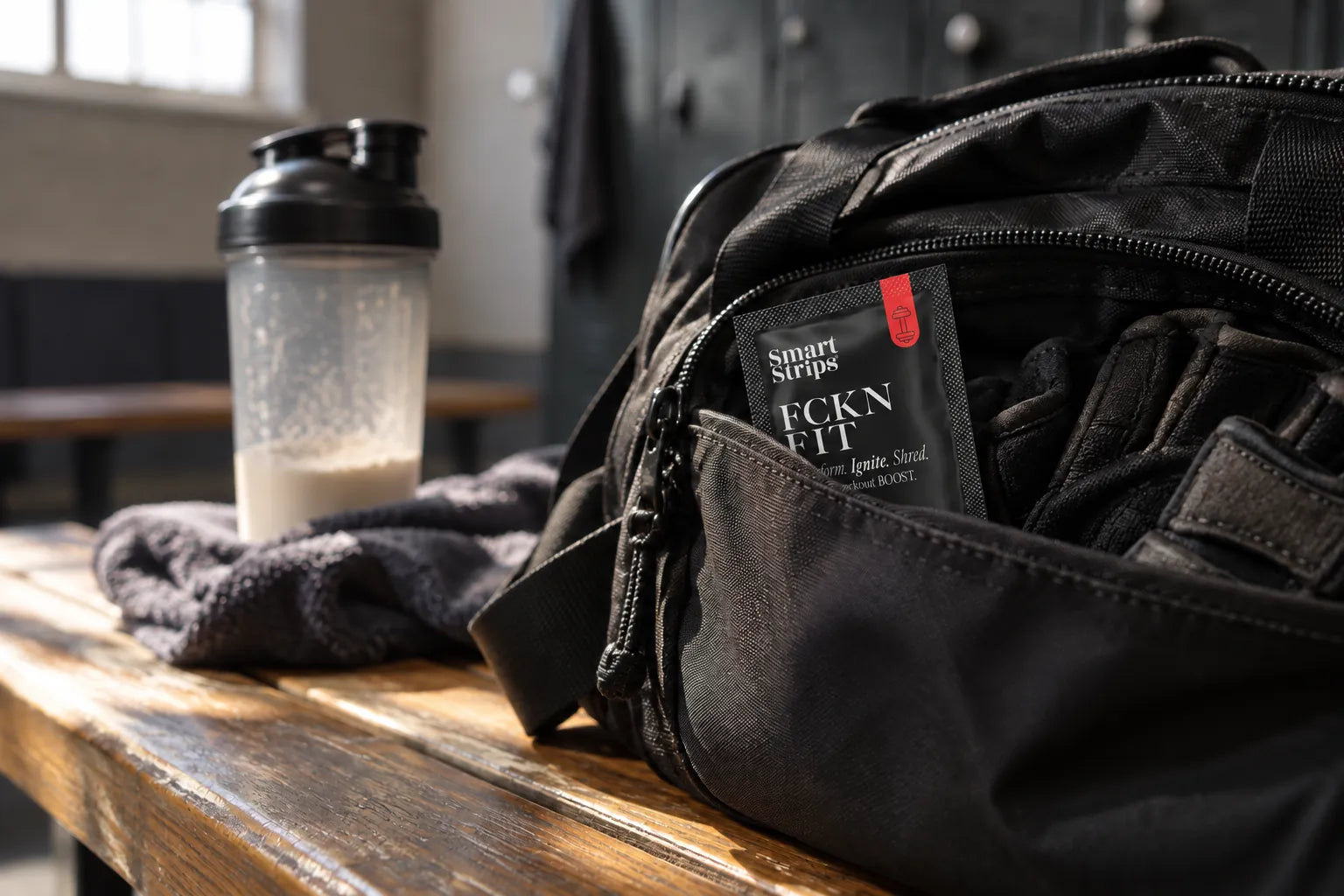
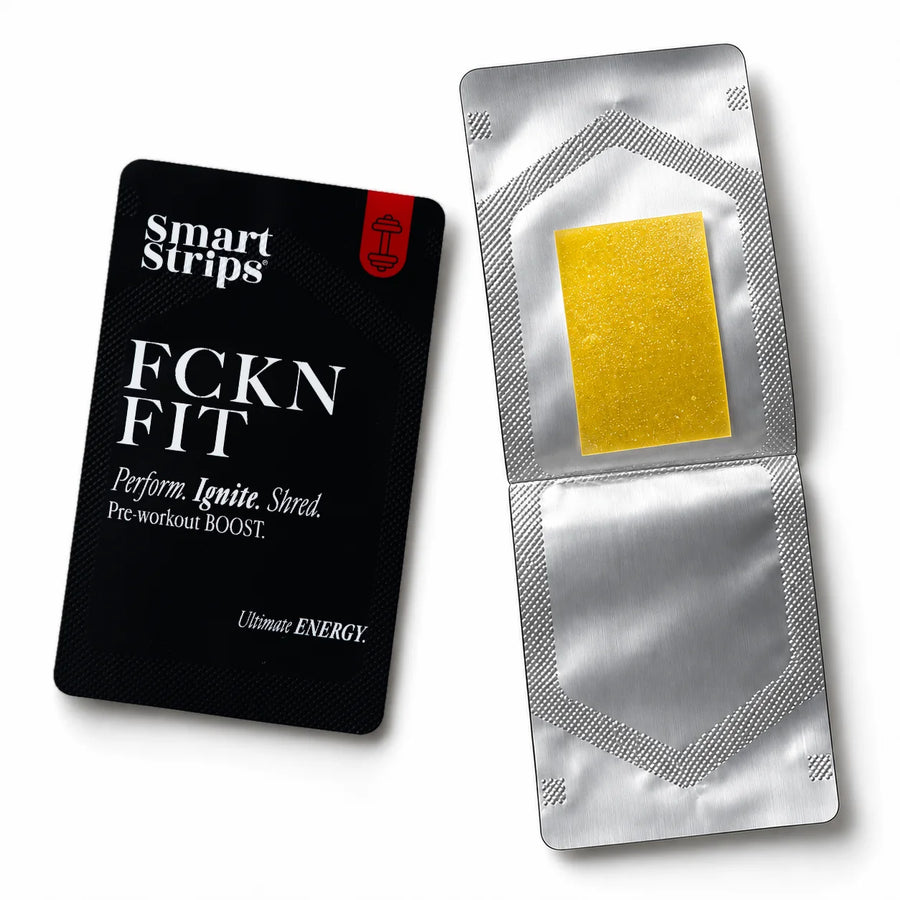
A strip needs a pocket. Each FCKN FIT strip is sealed in an 8 by 5 cm sachet that lives in the side pocket of the gym bag, next to the gloves. In the car park you open it, place the strip on your tongue, and by the time you have locked the car it has dissolved. No water bottle to fill, no grit at the bottom of the shaker, no scoop lost in the tub.
Part of each strip is absorbed through the lining of the mouth, and for the portion absorbed there, first-pass liver metabolism is significantly reduced. The lining under the tongue is only 100 to 200 µm thick, and “the portion of drug that is absorbed through the blood vessels directly enters the systemic circulation and bypasses hepatic first-pass metabolic processes” (Hua, Frontiers in Pharmacology, 2019). A review of oral delivery describes the mouth lining as 4 to 4000 times more permeable than skin (Patel et al., 2011), and for some molecules the difference is visible in medicines: selegiline in a form that dissolves in the mouth peaks in 10 to 15 minutes, against 40 to 90 minutes for the swallowed tablet (ZELAPAR prescribing information). For the format as a whole, Smart Strips works with up to 95% bioavailability, up to 4x faster absorption and up to 30% higher effectiveness. The part of the strip that is swallowed with saliva follows the usual route.
05
How long does caffeine take to work?
Caffeine is one of the fastest ingredients even when swallowed. In a study of healthy young men, caffeine taken as a drink was absorbed almost completely and reached its peak in the blood after about 30 minutes (Blanchard and Sawers, 1983). Food slows this down: in a study with much larger doses, the peak came 60 minutes after intake on an empty stomach and 120 to 180 minutes after intake with a meal (Skinner et al., 2013). Taking caffeine under the tongue does not automatically make it faster: a 2025 study found that a sublingual caffeine spray did not raise blood caffeine faster than espresso or an energy drink (McCarthy et al., 2025). FCKN FIT is among the Smart Strips products whose effect you can feel within the hour. Take it shortly before you start, and let the warm up do the rest.
06
FCKN FIT or FOCUS: which caffeine strip do I need?
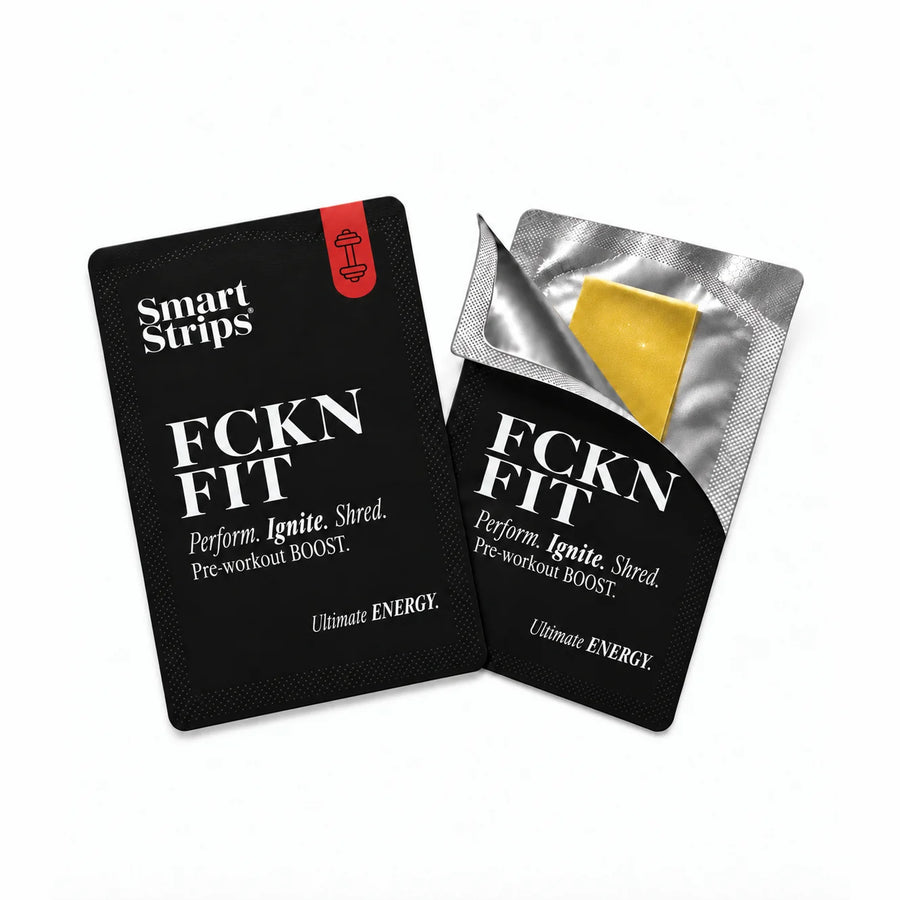
FCKN FIT is for the body before training. FOCUS is for the mind at the desk.
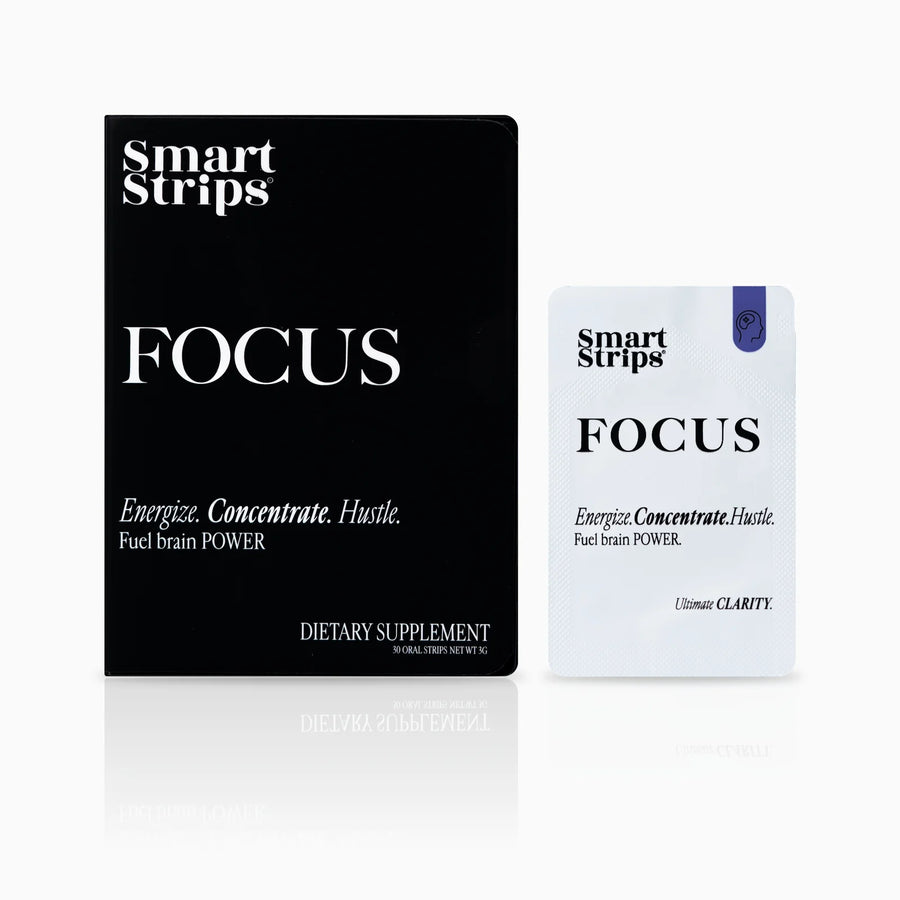
Both contain 20 mg of caffeine. FOCUS pairs it with L-theanine 10 mg, an amino acid found in tea, plus Alpha-GPC 20 mg, citicoline 10 mg and phosphatidylserine 5 mg. The pairing of L-theanine and caffeine is one of the most studied in nutrition research: a meta-analysis of 11 studies reported “moderate effect sizes in favor of combined caffeine and L-theanine” in the first two hours after intake (Camfield et al., 2014). Those studies used other amounts, for example 40 mg of caffeine with 97 mg of L-theanine (Giesbrecht et al., 2010), so we describe FOCUS by its contents rather than by their results. It suits the 3 p.m. slump before a board meeting, a long drive, or the second half of a day of exams, when another coffee would make you restless and you still need to think clearly.
If the next hour involves weights, take FCKN FIT. If it involves a spreadsheet, take FOCUS. Both stay at 20 mg, a fraction of a typical scoop, and for the other end of the day there is our page on melatonin strips vs gummies.
07
Caffeine strips vs pre-workout powder: side by side
| FCKN FIT oral dissolvable strip | Typical pre-workout powder | |
|---|---|---|
| Caffeine per dose | 20 mg | 91 to 387 mg per serving measured in Australia (Desbrow, 2019); about 254 mg on average on US labels (Jagim, 2019) |
| How you take it | On the tongue, dissolves in 7 to 30 seconds | Mixed with water in a shaker, then drunk |
| Equipment | None | Tub, scoop, shaker, water |
| Dose accuracy | One sealed strip per dose | Depends on the scoop |
| Ingredients with EU claims | Niacin, chromium | Varies by product |
| Other ingredients | L-carnitine 30 mg, GBBgo 5 mg, tamarind extract 5 mg | Varies by product |
| Carry | 8 by 5 cm sachet in the gym bag pocket | Tub at home or a pre-filled shaker |
08
Who should be careful with caffeine?
Caffeine is a stimulant even in small amounts. Please keep these in mind:
- Count your total caffeine for the day, including coffee, tea, energy drinks and other supplements. EFSA considers up to 400 mg a day acceptable for healthy adults, except pregnant women.
- Pregnancy and breastfeeding: EFSA considers up to 200 mg a day acceptable for pregnant women; please speak to your doctor before using caffeine supplements.
- Not intended for children or anyone under 18.
- If you are sensitive to caffeine, have a heart condition, high blood pressure or anxiety, consult your doctor first.
- Consult your doctor if you are pregnant, nursing, taking medication or have a medical condition.
- Stay within the daily intake on the box. Food supplements are not a substitute for a varied, balanced diet and a healthy lifestyle.
09
How to use FCKN FIT
Take one strip from its sachet with dry hands shortly before training. The strip is gone from the tongue within 7 to 30 seconds, and there is no water to find. Pulling the strip out and placing it on your tongue takes about seven seconds, the 7-second ritual, which makes it easy to turn into a habit, the same as putting on your gloves.

10
FAQ
What are caffeine strips?
Caffeine strips are oral dissolvable strips that carry a measured amount of caffeine on a thin film that dissolves on the tongue. FCKN FIT contains 20 mg of caffeine with L-carnitine, niacin, chromium, GBBgo and tamarind extract.
How much caffeine is in FCKN FIT?
20 mg per strip. Pre-workout powders measured in one market analysis contained 91 to 387 mg per serving (Desbrow et al., 2019).
Can I use FCKN FIT as a pre-workout without jitters?
It is designed for that. 20 mg is a light amount of caffeine, chosen for clean energy before training rather than strong stimulation. Sensitivity to caffeine differs from person to person.
How fast does an energy strip dissolve?
In 7 to 30 seconds on the tongue, without water.
What is the difference between FCKN FIT and FOCUS?
Both have 20 mg of caffeine. FCKN FIT adds L-carnitine, niacin, chromium, GBBgo and tamarind for training. FOCUS adds L-theanine, Alpha-GPC, citicoline and phosphatidylserine for work and study.
Can I take FCKN FIT with coffee?
Yes, as long as your total caffeine for the day stays within safe limits. EFSA considers up to 400 mg a day acceptable for healthy adults, except pregnant women.
11
Sources
- Desbrow B, et al. Caffeine content of pre-workout supplements commonly used by Australian consumers. Drug Testing and Analysis, 2019. https://researchportalplus.anu.edu.au/en/publications/caffeine-content-of-pre-workout-supplements-commonly-used-by-aust/
- Jagim AR, Harty PS, Camic CL. Common Ingredient Profiles of Multi-Ingredient Pre-Workout Supplements. Nutrients. 2019;11(2):254. DOI 10.3390/nu11020254
- EFSA Panel on Dietetic Products, Nutrition and Allergies (NDA). Scientific Opinion on the safety of caffeine. EFSA Journal. 2015;13(5):4102. DOI 10.2903/j.efsa.2015.4102. Serving values via EFSA, Caffeine: EFSA explains risk assessment (2015), https://www.efsa.europa.eu/sites/default/files/corporate_publications/files/efsaexplainscaffeine150527.pdf, and EUFIC, https://eufic.org/en/whats-in-food/article/efsa-opinion-on-the-safety-of-caffeine
- Smit HJ, Rogers PJ. Effects of low doses of caffeine on cognitive performance, mood and thirst in low and higher caffeine consumers. Psychopharmacology. 2000;152:167-173. DOI 10.1007/s002130000506
- Lieberman HR, Wurtman RJ, Emde GG, Roberts C, Coviella IL. The effects of low doses of caffeine on human performance and mood. Psychopharmacology. 1987;92(3):308-312. DOI 10.1007/BF00210835
- Commission Regulation (EU) No 432/2012, Annex (niacin and chromium claims). https://www.legislation.gov.uk/eur/2012/432/annex
- NIH Office of Dietary Supplements. Carnitine, Health Professional Fact Sheet (updated 17 April 2023). https://ods.od.nih.gov/factsheets/Carnitine-HealthProfessional/
- Volek JS, Kraemer WJ, Rubin MR, Gómez AL, Ratamess NA, Gaynor P. L-Carnitine L-tartrate supplementation favorably affects markers of recovery from exercise stress. Am J Physiol Endocrinol Metab. 2002;282(2):E474-E482. DOI 10.1152/ajpendo.00277.2001
- Spiering BA, et al. Responses of criterion variables to different supplemental doses of L-carnitine L-tartrate. J Strength Cond Res. 2007;21(1):259-264. DOI 10.1519/00124278-200702000-00046
- Vaz FM, Van Gool S, Ofman R, Ijlst L, Wanders RJ. Carnitine biosynthesis: identification of the cDNA encoding human gamma-butyrobetaine hydroxylase. Biochem Biophys Res Commun. 1998;250(2):506-510. DOI 10.1006/bbrc.1998.9343
- Rebouche CJ, Bosch EP, Chenard CA, Schabold KJ, Nelson SE. Utilization of dietary precursors for carnitine synthesis in human adults. J Nutr. 1989;119(12):1907-1913. DOI 10.1093/jn/119.12.1907
- Hua S. Advances in nanoparticulate drug delivery approaches for sublingual and buccal administration. Front Pharmacol. 2019;10:1328. DOI 10.3389/fphar.2019.01328
- Patel VF, Liu F, Brown MB. Advances in oral transmucosal drug delivery. J Control Release. 2011;153(2):106-116. DOI 10.1016/j.jconrel.2011.01.027
- ZELAPAR (selegiline orally disintegrating tablets), US Prescribing Information, clinical pharmacology. https://medlibrary.org/lib/rx/meds/zelapar/page/5/
- Blanchard J, Sawers SJA. The absolute bioavailability of caffeine in man. Eur J Clin Pharmacol. 1983;24(1):93-98. DOI 10.1007/BF00613933
- Skinner TL, Jenkins DG, Folling J, Leveritt MD, Coombes JS, Taaffe DR. Influence of carbohydrate on serum caffeine concentrations following caffeine ingestion. J Sci Med Sport. 2013;16(4):343-347. https://ro.uow.edu.au/smhpapers/2544
- McCarthy DG, Stapleton RK, Handy RM, et al. Sublingual caffeine delivery via oral spray does not accelerate blood caffeine increase compared to ingestion of caffeinated beverages. Eur J Appl Physiol. 2025;125(7):2007-2013. DOI 10.1007/s00421-025-05735-z
- Camfield DA, Stough C, Farrimond J, Scholey AB. Acute effects of tea constituents L-theanine, caffeine, and epigallocatechin gallate on cognitive function and mood: a systematic review and meta-analysis. Nutr Rev. 2014;72(8):507-522. DOI 10.1111/nure.12120
- Giesbrecht T, Rycroft JA, Rowson MJ, De Bruin EA. The combination of L-theanine and caffeine improves cognitive performance and increases subjective alertness. Nutr Neurosci. 2010;13(6):283-290. DOI 10.1179/147683010X12611460764840
7 to 30s
To dissolve on the tongue
8×5cm
Sachet, business card size
30
Strips, one month
10
Formulas, one format