


Last updated: 2026-10
A supplement held in the mouth meets a lining that, under the tongue, is only 100 to 200 micrometres thick (Hua, 2019), and the portion that crosses it reaches the circulation without first passing through the liver. A swallowed capsule takes the long way round: stomach, small intestine, then the liver, which for some compounds removes most of the dose before the rest of the body ever sees it.
That difference in route is the reason Smart Strips are made as oral dissolvable strips rather than capsules. Each strip dissolves on the tongue in 7 to 30 seconds. This guide covers what the mouth can absorb, where the evidence stops, and how to take a strip so that more of it stays where absorption can happen.
What does “sublingual” mean, and how is it different from buccal?
Sublingual means under the tongue. Buccal means the inside of the cheek. Both are part of the oral mucosa, the soft, moist lining of the mouth, and both can absorb certain substances directly into the small blood vessels beneath them.
The two areas behave differently. The lining under the tongue is 100 to 200 µm thick, the cheek lining 500 to 800 µm (Hua, 2019), and permeability decreases in that order: highest under the tongue, then the cheek, then the palate (Shojaei, 1998). That is why fast-acting prescription tablets are often designed to sit under the tongue. The cheek lining absorbs more slowly, but it is a calmer place to hold something for longer, because the tongue moves less against it.
An oral dissolvable strip sits somewhere in between. You place it on the tongue, it turns into a thin film of liquid within seconds, and that liquid spreads across the tongue, under it and along the cheeks. In practice a strip uses several areas of the mucosa at once.
How does absorption through the oral mucosa work?
Substances pass through the oral mucosa mainly by diffusion: they move from where they are concentrated (the dissolved strip in your saliva) to where they are not (the blood under the lining). The lining is thin and, unlike skin, not keratinised, so the distance to travel is short. A review of oral delivery describes the lining of the mouth as “4-4000 times more permeable than that of skin” (Patel et al., 2011).
What happens next is the important part. The portion absorbed this way reaches the general circulation without passing through the liver first. Prescribing information for one medicine given this way, selegiline in a form that disintegrates in the mouth, attributes its higher blood levels to absorption before the stomach and the avoidance of first-pass metabolism (ZELAPAR prescribing information). Note the word “portion”, because it matters later in this guide.
What is first-pass metabolism, and why should a supplement buyer care?
First-pass metabolism is the processing a swallowed substance goes through before it reaches general circulation. Everything absorbed from the gut travels first through the portal vein to the liver, and the liver breaks down a share of it. How large that share is depends entirely on the molecule.
Two well-documented examples show the range. In medicines, the prescription drug asenapine has a bioavailability of 35% when it dissolves under the tongue and under 2% when it is swallowed (SAPHRIS prescribing information), which is why it is given under the tongue. Closer to the supplement shelf, oral melatonin tablets at 2 mg and 4 mg “showed an absolute bioavailability of approximately 15%” (DeMuro et al., 2000). In plain terms, roughly 85 parts out of 100 of a swallowed melatonin tablet did not reach circulation in that study.
Not every ingredient loses that much. Caffeine is the clearest counterexample: swallowed in solution, it was absorbed essentially completely, with a measured absolute bioavailability of 108.3 ± 3.6% (Blanchard and Sawers, 1983). For ingredients like that, the swallowing route works well. The point is that the route is a variable, and most supplement labels never mention it.
How much better is sublingual absorption than swallowing?
There is no single multiplier that holds for every ingredient. The result depends on the molecule, and the studies that compare one substance in two forms show both the potential and its limits:
- Melatonin. In 13 healthy men, a 1 mg sublingual spray reached peak blood levels at 23.3 minutes on average, a 1.9 mg prolonged-release tablet at 64.2 minutes (Ait Abdellah et al., 2023). Part of that gap comes from the tablet being designed to release slowly, so the comparison is not perfectly fair, but it points in the expected direction. A systematic review concluded that “oral transmucosal administration of melatonin exhibited a high plasma concentration compared to oral administration” (Zetner et al., 2016).
- Caffeine. A 2025 study found that “sublingual administration of caffeine via mouth spray did not increase serum caffeine concentration faster than ingesting caffeinated beverages” (McCarthy et al., 2025). Caffeine is absorbed quickly from the gut anyway: swallowed in solution, it reached peak blood levels after 29.8 minutes on average (Blanchard and Sawers, 1983). The mouth has less to add.
The fair conclusion: for ingredients that the liver or the stomach break down heavily, the mouth can make a meaningful difference. For ingredients the gut already absorbs well, the main gains are speed of taking, convenience and the absence of water, which are real benefits of a different kind.
Does some of the strip get swallowed anyway?
Yes, and anyone who tells you otherwise is overselling. Saliva keeps flowing while a strip dissolves, and you swallow regularly without noticing. Part of the dissolved strip goes down with it.
Prescription products give a sense of scale. In the labeling of one prescription buccal film, about 51% of the dose was absorbed through the lining of the mouth and the rest was swallowed (ONSOLIS prescribing information). That film is a mucoadhesive product designed to stick to the cheek, not a freely dissolving strip. For supplement strips the exact proportion has not been measured, and it will differ by ingredient and by how the strip is taken.
The swallowed portion is not lost. It follows the ordinary digestive route, with the same absorption and the same first-pass processing as a capsule. So the honest description of an oral dissolvable strip is a format that gives part of the dose a shorter route, while the rest travels the usual way. That is also why the way you take the strip matters, as the section below explains.
Which ingredients absorb well through the mouth?
The ingredients that suit the oral mucosa tend to share a profile: small molecules, a dose measured in milligrams or micrograms rather than grams, and a balance between fat solubility and water solubility. An overview for developers of sublingual tablets, written by FDA scientists, lists a molecular weight below 500 and a log P (a measure of how fat-soluble a molecule is) between 1 and 5 as favourable (Sayeed and Ashraf, 2014). A substance needs enough water solubility to dissolve in saliva and enough fat solubility to pass through the cell membranes of the lining. Molecules at either extreme cross poorly.
Melatonin is the best-documented supplement example, which is one reason the 1 mg dose in Z-z-Zen sits in a strip. Caffeine absorbs from the mouth too, although, as the 2025 study showed, not necessarily faster than from a coffee. The 20 mg of caffeine in FOCUS and FCKN FIT is in a strip mainly because you can take it anywhere, with nothing to drink.
Which ingredients don’t belong under the tongue?
Large doses are the clearest limit. A strip carries milligrams. Protein, creatine, fish oil or a gram of vitamin C will never fit, and no format can push grams of material through a lining this thin in the time a strip spends in the mouth. If your goal needs grams, a powder or a capsule is the right tool, and a strip is the wrong one.
Very large molecules are the second limit. Proteins and long peptides are far above the molecular weight that favours sublingual uptake, and they cross the mucosa poorly in general. Ingredients that are meant to act in the gut itself, such as fibre or probiotics, gain nothing from a shortcut around it.
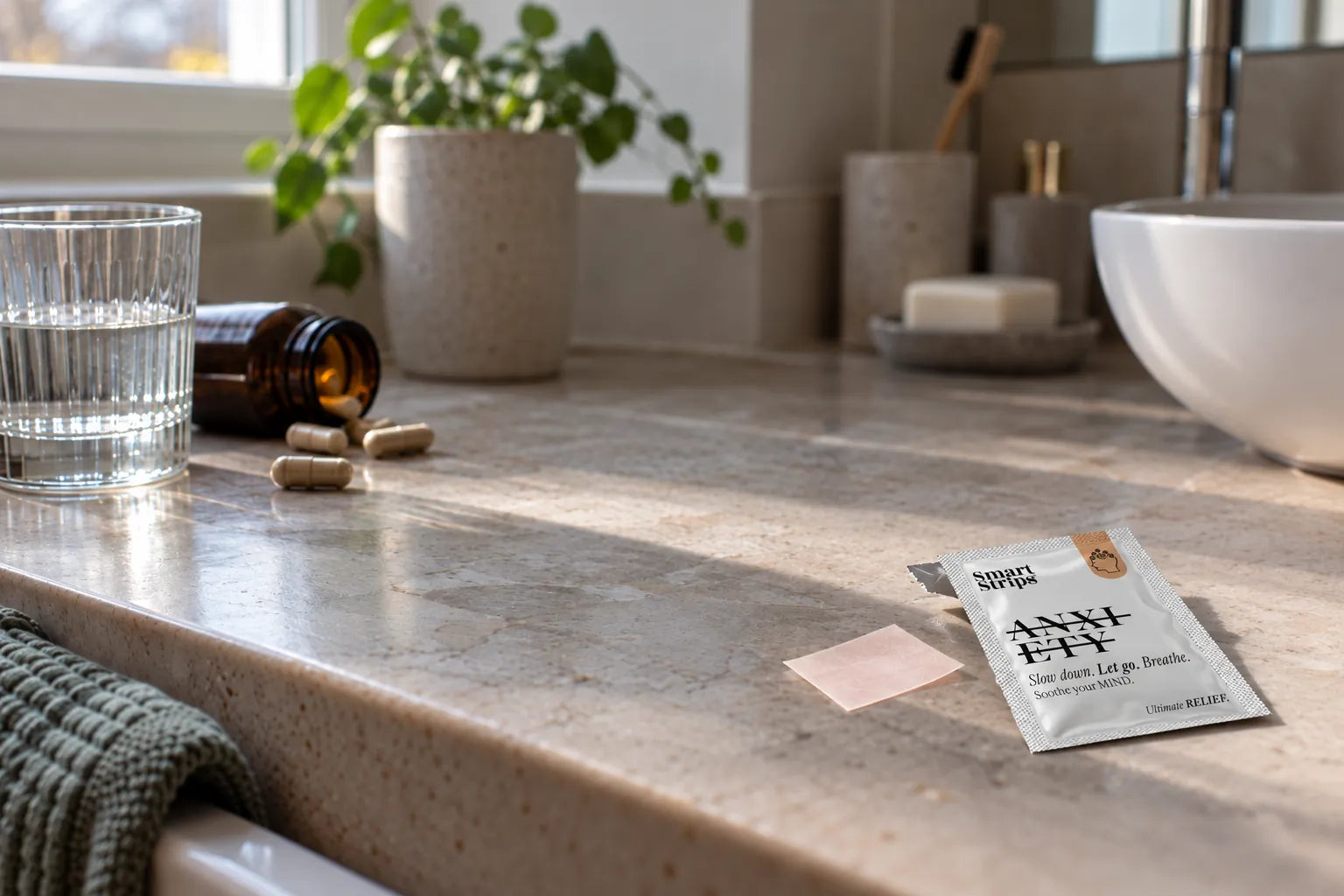
How should you take an oral strip for maximum absorption?
Keep the strip in your mouth until it has fully dissolved and avoid swallowing for those seconds. Everything else is detail, and these details help:
- Dry fingers. A pullulan strip starts dissolving on contact with moisture. Wet fingertips mean part of it stays on your hand.
- Place it on the tongue, flat. The strip dissolves on the tongue in 7 to 30 seconds. Pressing it lightly against the roof of the mouth or moving it under the tongue keeps it in contact with the lining.
- Don’t chew, don’t swallow straight away. Let the dissolved film sit and spread. The longer the liquid stays in the mouth, the more chance the lining has to absorb it.
- Wait before you drink. A glass of water right after the strip washes the rest of it into the stomach. Give it a few minutes. Sublingual medicines show why: for asenapine, water taken 2 minutes after the dose lowered exposure by 19%, and at 5 minutes by 10% (SAPHRIS prescribing information). No study has set an exact number of minutes for supplement strips, so a few minutes is practical guidance modelled on those labels.
- Take it at the right moment. Z-z-Zen goes on 30 minutes before bed. FCKN FIT goes on 15 to 30 minutes before training. Timing affects how well an ingredient fits your day as much as the route does.
The opening gesture is quick: tear the sachet, place the strip, done. We call that the 7-second ritual. The dissolving takes its own 7 to 30 seconds, and those seconds are worth giving it.
Sublingual vs swallowed: a side-by-side view
| Oral dissolvable strip | Swallowed tablet or capsule | |
|---|---|---|
| Where absorption starts | Mouth lining, then the swallowed part in the gut | Stomach and small intestine |
| First-pass liver processing | Reduced for the portion absorbed in the mouth | Applies to the whole absorbed dose |
| Water needed | No | Yes |
| Typical dose range | Micrograms to tens of milligrams | Milligrams to grams |
| Best suited to | Small molecules in small doses | Large doses, gut-targeted ingredients |
For a full comparison of formats, including gummies and powders, see oral strips vs pills, capsules and gummies. For the wider question of why a supplement can fail even when the ingredient is right, read why your supplements aren’t working.
If you are pregnant, nursing, taking medication or have a medical condition, consult your doctor before using any supplement.
The simplest test is your own evening. Place a Z-z-Zen strip on your tongue shortly before bed, let it dissolve, and notice how little the routine asks of you. Explore Z-z-Zen or browse the full range.
Comparing formats rather than absorption routes? Read oral dissolvable strips vs sublingual tablets.
FAQ
Are sublingual supplements better than pills?
For some ingredients, yes. Molecules that the liver breaks down heavily, such as melatonin (about 15% bioavailability when swallowed as a tablet, DeMuro 2000), can benefit from absorption through the mouth. For ingredients the gut absorbs well, the main advantages are convenience and no water.
What is buccal absorption?
Buccal absorption is absorption through the inside of the cheek. The cheek lining is thicker than the area under the tongue and absorbs more slowly, but it is part of the same oral mucosa.
Does an oral strip skip the liver completely?
No. The portion absorbed through the mouth lining avoids first-pass liver processing. The portion swallowed with saliva follows the normal digestive route.
How long does a Smart Strips strip take to dissolve?
7 to 30 seconds on the tongue.
Should I drink water after taking an oral strip?
Wait a few minutes. Drinking straight away washes more of the dissolved strip into the stomach; in a sublingual medicine, water at 2 minutes lowered exposure by 19%.
Can I take a sublingual strip with food in my mouth?
It is better on a clean, empty mouth, so the strip has full contact with the lining and is not swallowed with food.
Sources
- Hua S. Advances in nanoparticulate drug delivery approaches for sublingual and buccal administration. Front Pharmacol. 2019;10:1328. DOI 10.3389/fphar.2019.01328
- Shojaei AH. Buccal mucosa as a route for systemic drug delivery: a review. J Pharm Pharm Sci. 1998;1(1):15-30. https://sites.ualberta.ca/~csps/JPPS1(1)/A.Shojaei/buccalreview.htm
- Patel VF, Liu F, Brown MB. Advances in oral transmucosal drug delivery. J Control Release. 2011;153(2):106-116. DOI 10.1016/j.jconrel.2011.01.027
- ZELAPAR (selegiline hydrochloride) orally disintegrating tablets, US Prescribing Information, Clinical Pharmacology. https://medlibrary.org/lib/rx/meds/zelapar/page/5/
- SAPHRIS (asenapine) sublingual tablets, US Prescribing Information, Clinical Pharmacology. https://medlibrary.org/lib/rx/meds/saphris-1/page/6/
- DeMuro RL, Nafziger AN, Blask DE, Menhinick AM, Bertino JS. The absolute bioavailability of oral melatonin. J Clin Pharmacol. 2000;40(7):781-784. DOI 10.1177/00912700022009422
- Blanchard J, Sawers SJA. The absolute bioavailability of caffeine in man. Eur J Clin Pharmacol. 1983;24(1):93-98. DOI 10.1007/BF00613933
- Ait Abdellah S, Raverot V, Gal C, et al. Bioavailability of melatonin after administration of an oral prolonged-release tablet and an immediate-release sublingual spray in healthy male volunteers. Drugs R D. 2023;23(3):257-265. DOI 10.1007/s40268-023-00431-9
- Zetner D, Andersen LPH, Rosenberg J. Pharmacokinetics of alternative administration routes of melatonin: a systematic review. Drug Res (Stuttg). 2016;66(4):169-173. DOI 10.1055/s-0035-1565083
- McCarthy DG, Stapleton RK, Handy RM, et al. Sublingual caffeine delivery via oral spray does not accelerate blood caffeine increase compared to ingestion of caffeinated beverages. Eur J Appl Physiol. 2025;125(7):2007-2013. DOI 10.1007/s00421-025-05735-z
- ONSOLIS (fentanyl buccal soluble film) US Prescribing Information, NDA 022266, 2021, Clinical Pharmacology. https://www.accessdata.fda.gov/drugsatfda_docs/label/2021/022266s025lbl.pdf
- Sayeed VA, Ashraf M. Considerations in developing sublingual tablets: an overview. Pharmaceutical Technology. 2 November 2014. https://www.pharmtech.com/view/considerations-developing-sublingual-tablets-overview